Category Archives: Writing the Case for Support
Tell them; then convince them.
When writing a grant application you need to be direct. Begin each paragraph with its main message. Then use the rest of the paragraph to convince them that the message is true. In the book we refer to this style … Continue reading

Committees and Referees
The Journal Nature reported yesterday that scientists have complained that there is a mismatch between expert referees’ evaluation scores of research grant applications and funding decisions. Different interviewees claimed that this mismatch either does or does not indicate either a … Continue reading
Reshape Your Draft Grant Application
Last week I explained how to tell if your grant application is misshapen. Here I describe how to get it into shape. Let’s start with the most difficult kind of draft to deal with, one in which it’s hard to tell … Continue reading
The misshapen monster and the zombie grant
What do you do when your grant application (or your colleague’s) turns out to be a misshapen monster? How do you even know if it has? Can you tell if it’s just a little bit deformed? Read on. This post … Continue reading
Research Grant Cookbook
Is there a recipe for the 10 key sentences? This post is about an easy way to work out how to write the 10 key sentences that define a grant application. There are two reasons I think it’s worth writing … Continue reading
The Summary: Your Direct line to Committee Feelgood
Not many people realise that the summary section on your grant application is a direct line to the most influential member of the committee that decides where it sits in the funding priorities. You can make this person feel really … Continue reading
Aims and Objectives: What you want to achieve and how you will achieve it.
Aims and objectives provide an excellent framework for the case for support in a research grant application. A well-written case for support states an overarching aim based on a big research question. It shows how this big question gives rise to three or four smaller questions … Continue reading
Put Some Meat in Your Feedback Sandwich
This is one of a series of posts with advice for people who review grant applications for their friends and colleagues. It is also intended to encourage people writing grant applications to review what you have written before you ask a colleague to … Continue reading
Get the Framework in Place – Quickly
In this post I want to describe the framework of a grant application. Its components are the key sentences in the case for support that define its essential message. I will explain what the sentences are and how you use them … Continue reading
Are you ready to start?
In this post I will tell you how to decide whether you should start writing a grant application. In essence it’s about how to check whether you have a viable, fundable research project before you go to the trouble of … Continue reading
Five Minute Feedback
With the popular British Academy/Leverhulme Small Grant deadline looming, I am asked to comment on several draft applications per day. My comments are surprisingly consistent as I read each new draft and give feedback using ‘track changes’: Comment (JA1) Your … Continue reading
Be Prepared
In this post I want to tell you how you can be prepared to write a grant application quickly and with minimum effort. Last week I warned you about the trap of the never-ending grant application. This week I am … Continue reading
The trap of the never-ending grant application
This post outlines my theory of the trap of the never-ending grant application. There’s a very old joke about a tourist, driving in Ireland, who asked the way to Dublin. “If I were driving to Dublin” was the response, “I … Continue reading
Guardian Live Chat
I recently had the pleasure of taking part in a live chat, on the Guardian Higher Education website, about how to write successful grant applications. It was very interesting for me because the rapid flow of questions made it impossible for me … Continue reading
Writing by Numbers: the Case for Support in 7 Easy Steps.
This post is a step by step guide to writing the case for support in a research grant application. It describes the structure of the generic case for support and tells you what steps you should take to write it … Continue reading
Writing the introduction:- Getting your Foot in the Door
This post is about the easy way to write the first part of the generic case for support for a research grant application. As I have explained in a previous post the first section of the case for support should … Continue reading
We have a problem: writing the second part of the case for support.
This post is about writing the section of the case for support that convinces the reader that the research project you propose to do is really important and deserves to be supported with a grant. In the book, we call … Continue reading
Describing your research project.
In this post I want to discuss how to build up a full description of a research project. The description of the research project is the last and biggest part of the generic case for support. Its length should be … Continue reading
You can take an academic to a grant-writing workshop but…
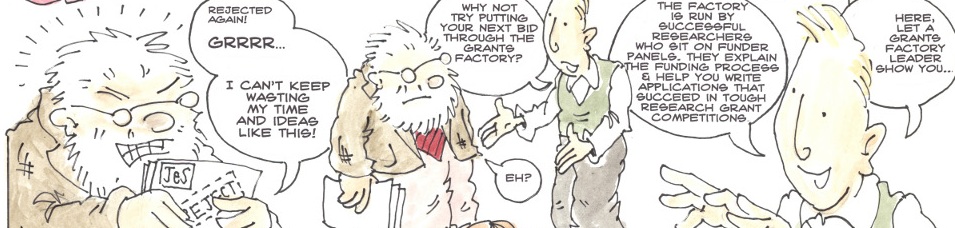
The poster describing the University of Kent Grants Factory won first prize at the ARMA conference in Southampton last week. I have put a pdf of the poster, which is brilliantly drawn by Phil Ward, on the resources page. The … Continue reading
How to Start Writing the Case for Support
This post is about how you actually start writing a research grant application. I argued last week that the first part you should write is a detailed description of the research project. This can be difficult because the decision to … Continue reading